Emerging technologies that will transform the world
Discover these emerging technology trends that have the power to change our future.
Advertisements
Have you ever stopped to think about how emerging technologies are transforming the world around us? Every day, innovations emerge and significantly impact the way we live, work and relate to each other.
Therefore, as we move into the future, it is essential to keep up with these technological trends, both to stay up to date and to actively participate in the changes they will bring.
So, in this post, we will explore some of the emerging technologies with the greatest potential to shape and impact our future and how they are about to revolutionize various sectors of our society. Check it out now!
1. Artificial Intelligence
Artificial intelligence has been a major player in the technological revolution of recent years. With innovative algorithms and unprecedented data analysis capabilities, this technology is transforming sectors such as healthcare, logistics and finance.
Additionally, AI is also driving the automation. This is because it is making repetitive tasks more efficient and freeing up time for more creative and strategic activities, which are still difficult for a machine to perform.
While AI can automate repetitive tasks, it is also creating new job opportunities. Thus, a report by the World Economic Forum estimates that artificial intelligence will create 12 million new jobs by 2025. Among the affected areas we find: data intelligence, software development and technical support.
2. Blockchain
Blockchain is about much more than just the technology behind cryptocurrencies. After all, it is a secure and transparent way to record transactions and ensure data integrity. As such, companies are using Blockchain to track supply chains, and improve cybersecurity.
Furthermore, blockchain is expanding into governance. Smart contracts and voting systems based on this emerging technology can make democratic processes more transparent and secure.
This can have significant implications for how societies are run and for relationships between citizens and governments.
According to the Global Blockchain Technology Market 2021-2026 report by MarketsandMarkets, the blockchain technology market is expected to grow at a CAGR of an impressive 67,3% during the period 2021 to 2026.
3. Internet of Things
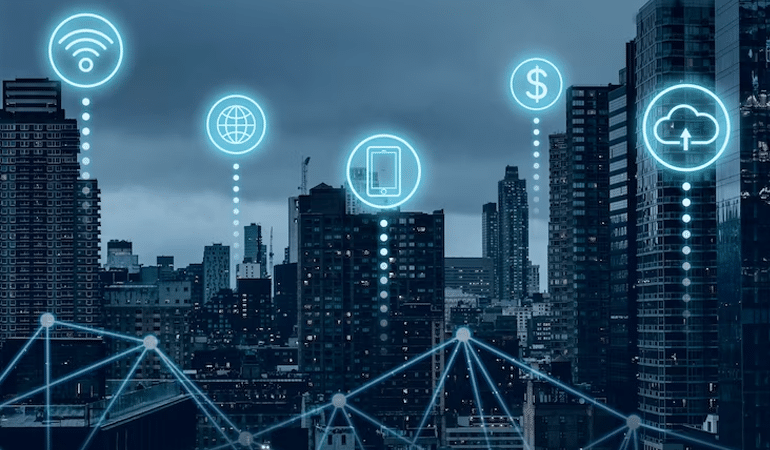
IoT connects devices all around us and its expansion is inevitable. In the future, refrigerators will not only order groceries on their own, but will also be able to manage their inventory and create smart shopping lists. In addition, smart houses and connected cities will make our lives more efficient and sustainable.
However, it is worth mentioning that the Internet of Things is not restricted to a specific sector. After all, it is being widely adopted in many fields. For example, in agriculture, IoT helps farmers monitor crop growth and optimize irrigation.
In healthcare, connected medical devices are revolutionizing patient monitoring. In smart cities, sensors collect data to improve traffic and air quality.
And the future is even brighter. Data from IDC predicts that by 2025, there will be more than 41 billion devices connected to the internet worldwide. This massive expansion will include not only smartphones and computers, but also a wide range of devices – from smart home appliances to sensors in urban areas.
4. Edge Computing
Edge Computing, or 'computing at the edge', refers to a paradigm that places data processing power closer to where it is generated, as opposed to the traditional model, which centralizes processing in data centers distant. In other words, computing occurs 'at the edge' of the network closest to end devices and users.
Bringing information processing closer together improves user security, as data can be processed locally. This reduces exposure to cyber threats.
According to research firm MarketsandMarkets, the Edge Computing industry is expected to reach $43,4 billion by the year 2027, with a compound annual growth rate of 34,1%.
5. 3D printing
3D printing is evolving rapidly, moving from manufacturing simple prototypes to mass production. Large scale of complex, custom parts. This has significant implications for the manufacturing industry, where on-demand production could transform the way products are made and delivered.
The healthcare sector is another sector that has been greatly impacted by 3D printing resources. This is because it is transforming medicine, allowing the creation of personalized prosthetics and even artificial organs, which can replace organ donation.
According to SmarTech Publishing, the 3D printing market in medicine is expected to grow at a compound annual rate of 15% through 2027. Such data only shows us how promising this technology is.
So, did you enjoy learning about these emerging technologies? Share this content with your friends on social media who also love to stay up to date with scientific innovations. See you later!